On the mornings when the tide pulls back and leaves the marsh air cool, I love how everything looks quietly rearranged—like the day is giving you a second chance to notice.
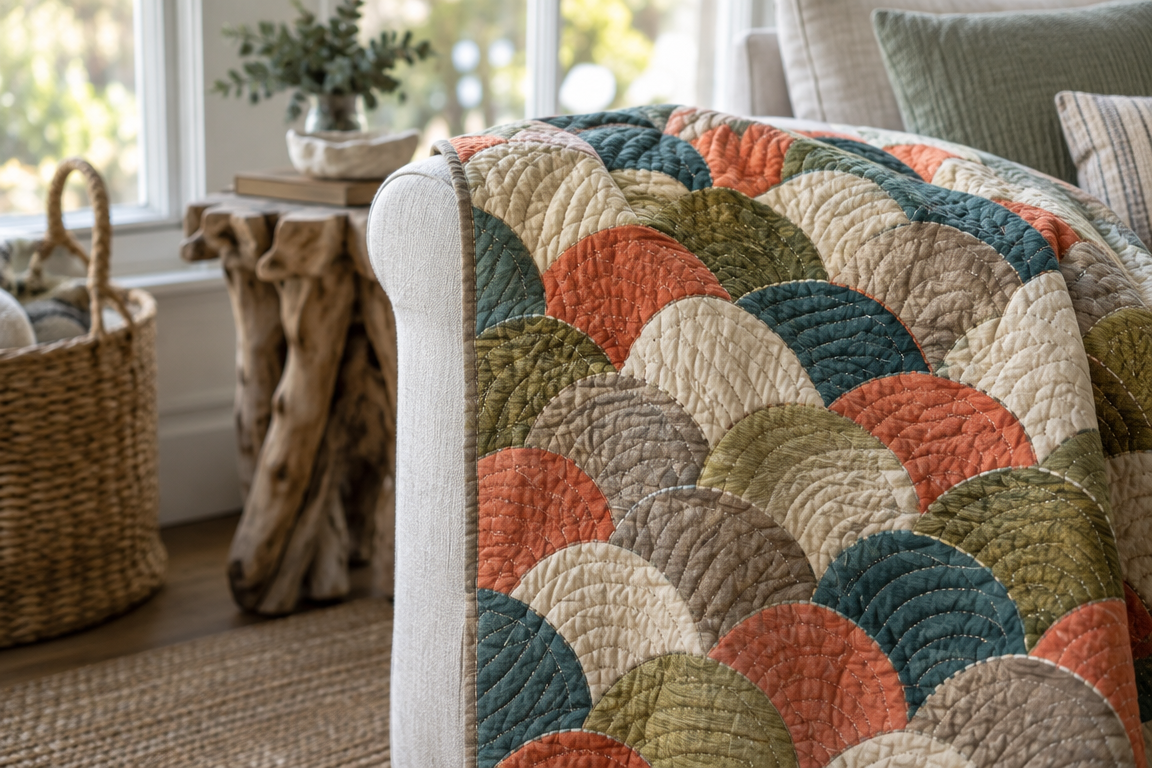
I made Ebb Interval as my own little pause between busy seasons, stitching 4-inch clamshells that feel like scalloped ripples settling into place.
Each block is cut from a different fabric, so the surface reads as overlapping waves rather than one repeating pattern.
When I drape it over the arm of my pale linen settee, it always reminds me of eelgrass channels and the slow shimmer of pooled water at the edge of the marsh.
I kept the palette moving—oxidized-copper teal to spartina olive to marsh-clay taupe—so the whole throw looks like it’s slowly fading out and brightening again.
Ready to make your own ebb-and-flow quilt rhythm?
SEE A NEW PATTERN HEREThe Look of Ebb Interval (and Why It Feels Like Moving Water)
This quilt is built entirely from the same 4-inch finished clamshell block, which is the kind of repeating unit that lets your eye follow the flow.
Instead of a solid background, every scallop comes from a different fabric, so the “overlap” you see is really fabric depth and placement doing the storytelling.
The autumn mood comes through in warm neutrals and marsh clays, while the teal family keeps the waterline feeling alive.
A few diagonal split clamshells catch the light in a pooled-water way, like two colors meeting under a thin veil of reflection.
Color-Play That Reads as Ripples at Receding Tide
I designed the palette to travel from oxidized-copper teal into spartina olive, then into oyster-cream and marsh-clay taupe, so the quilt never feels flat.
For the coral-orange glasswort accents, I used small, intentional pops so they feel like strands of marsh plant you spot only when the light changes.
Those narrow ribbon rows of graded teal thread add a subtle “eelgrass channel” effect that crosses the shell pattern like movement you can almost hear.
Materials for the Throw-Size Ebb Interval Quilt
- Fat quarters or small yardage mix for clamshell fabrics: about 12–16 different fabrics (enough to yield roughly 3–5 fat quarters worth of contrast pieces)
- Accent fabric for pooled-diagonal clamshells: about 1/2 yard
- Ribbon-row teal fabric (or a dedicated strip set fabric if you’re choosing a match): about 1/3 yard
- Backing fabric: 3 1/2 yards
- Batting: 60 x 76 inches (or a throw-size equivalent)
- Binding: 1/2 to 5/8 yard (depending on your preferred binding width and seam allowance)
- Thread: neutral all-purpose for piecing plus a graded teal thread set for the ribbon-row stitching (choose weights that match your machine)
Because Ebb Interval uses many different fabrics, I recommend pre-sorting your fat quarters by value (light, medium, deep) so your ripples read in layers.
If you’re mixing diagonally split clamshells, set aside a couple fabrics specifically for that effect so the “pooled water” moments feel intentional.
Prep and Workspace: Keeping Curves Crisp
I start by clearing a cutting space and setting up a bright lamp, because curved pieces reward careful accuracy.
Then I make freezer-paper templates for the clamshell curves, which helps the edges stay steady while you sew and press.
Before the first seam, I press each fabric section lightly and mark the key points on the paper template so nothing drifts during assembly.
Once I’m confident my pins and stitching line up on a test piece, I settle in and sew the rest like a gentle routine.
The Downloadable Pattern Lives Right Below
The full instructions for Ebb Interval—including the block steps, template placement, and how to assemble the throw layout—are below the photo/in the link.
If you’d like, you can preview the quilt’s overall direction first, then follow the downloadable pattern for each curving clamshell sequence.
| Full Pattern | PDFClick Here |
Tips for a Cleaner Curved Finish
When I sew curves, I trim threads often and press with patience, letting the iron shape the fabric instead of forcing it.
To keep the clamshells sharp, I use small, consistent seam allowances and avoid stretching while feeding the fabric through the machine.
After each block, I take a moment to square up lightly if needed so the grid stays true when the throw comes together.
For the diagonal split “pooled water” pieces, I check the fabric orientation twice before stitching so the tonal meeting point lands where I want it.
Optional Upgrade: Eelgrass Channels and a More Advanced Spin
If you want to push beyond the base construction, you can experiment with free-motion quilting in the background areas to mimic current trails without flattening the scallops.
Another fun option is adding thin borders made from marsh-clay taupe and oyster-cream so the center ripples feel framed like a tide pool.
And if you love scraps, Ebb Interval actually welcomes them—just keep a balanced spread of values so the overlapped look stays readable.
Celebrate Your Ebb Interval Throw
When the last clamshell is stitched, the quilt almost looks like it’s caught mid-breath—ripples left behind, then softening into the next moment.
After quilting and binding, I always drape it over the nearest chair or sofa arm to check the depth of the overlapping scallops in real light.
If this threw you into a tidal mood, I’d love for you to keep going and find another project on the Quilt Dreams blog that matches your season of stitching.