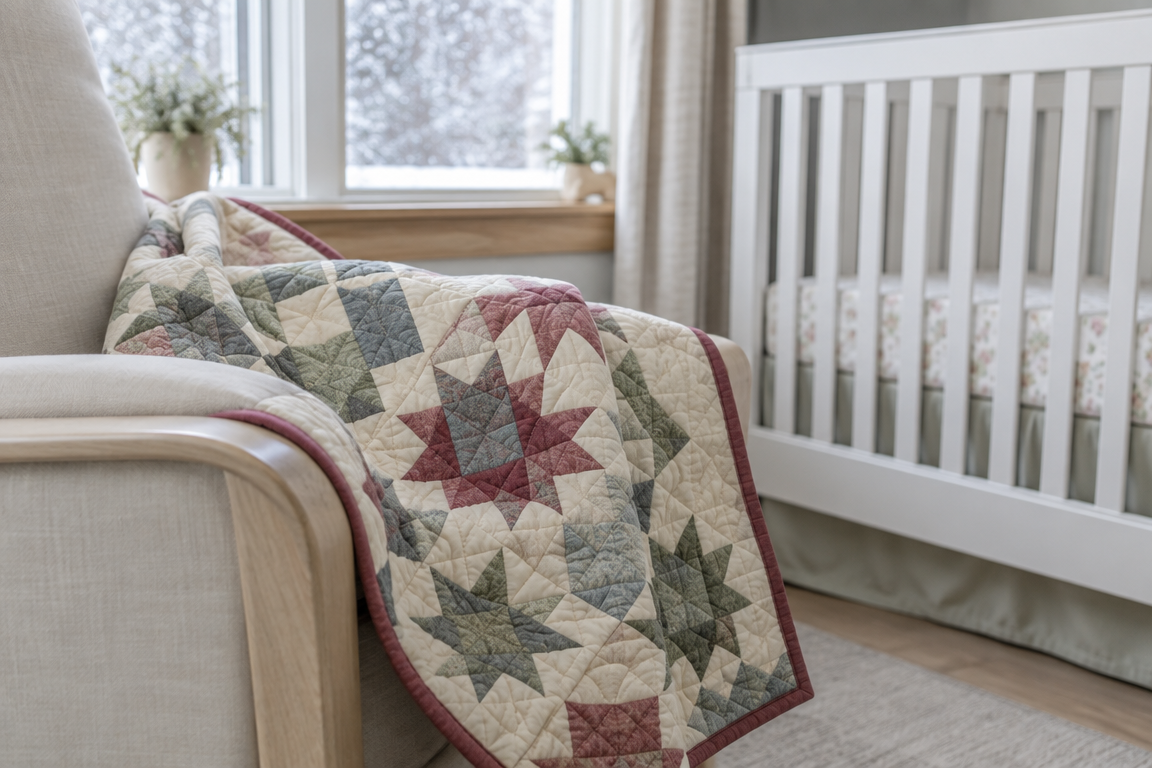
This morning, I found myself staring at the glider in our nursery corner, imagining how this little crib quilt will look when the room is still half-sleepy and the light feels brand-new.
SEE A NEW PATTERN HERE
I wanted a quilt that feels like winter starlight without getting too dramatic, so I built it around crisp points and gentle flannel warmth.
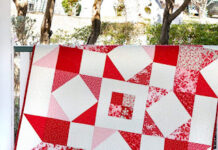
The Star of the New Morning blocks are sweetly bold, and the square-in-square companions keep the whole layout calm and cozy for a newborn.
I also loved the idea of low-volume snowflake and dot prints tucked between the stars, so the design reads clearly even at crib distance.
When I draped the finished quilt over the arm of a pale oak glider, it looked like a soft snowfall waiting for a first yawn.
If you’re ready to sew something that feels like comfort wrapped in starlight, here’s the pattern you’ll want to make.
Why this quilt feels special at first glance
Starry baby quilts always tug at my heart, but this one is designed to feel balanced—bright enough to be memorable, soft enough for everyday cuddles.
The alternating 12-inch Sawtooth Star blocks and square-in-square blocks create a rhythm that feels like morning light spreading across snow.
Because the stars are framed with pale oatmeal flannel sashing, the points stay crisp and the rows look neat and intentional.
Color play that keeps the stars sharp
I pieced the flannel in cream, dove grey-blue, soft sage, and muted raspberry to get that winter palette that’s both soothing and slightly sparkly.
Instead of using high-contrast prints everywhere, I chose low-volume snowflake and tiny dot fabrics to sit quietly between the stars.
This way, your eye catches the star points first, and the background prints feel like gentle texture rather than noise.
Materials you’ll need for Star of the New Morning
- Flannel fat quarters/quarters in cream, dove grey-blue, soft sage, and muted raspberry (plan for about 10–12 fat quarters total, depending on print direction)
- 12-inch Sawtooth Star 12-inch block pieces: additional coordinating flannel for small piecing accents (about 1 yard total across colors)
- Oatmeal flannel for wide sashing: about 1 1/2 yards
- Backing: warm oatmeal print flannel, about 2 1/2 yards
- Batting: crib-size flannel-friendly batting, about 2 3/4 yards (or the closest crib-size you prefer)
- Raspberry binding: about 3/4 yard of flannel for binding strips (or enough to cut straight strips to match your method)
For the best drape with flannel, I like a batting with a little loft that still stays soft after quilting, especially for a newborn quilt meant for snuggling.
If you’re mixing prints, give yourself some breathing room in the fat quarter count so the snowflake/dot fabrics don’t run short for the between-star spaces.
Prep in your sewing space (so the blocks behave)
Start by prewashing and drying your flannel fabrics the same way you’ll wash the finished quilt, because flannel loves to move a little before it settles.
Then press your seams consistently—snug and flat—so the sawtooth points turn sharp rather than bulky.
I also recommend labeling your fabric piles as you go (star lights, star blues, star greens, star berry, and background snow), because winter palettes can look similar when you’re midway through.
Follow the full instructions in the pattern PDF
Below you’ll find the photo of the quilt layout, and the complete sewable instructions live in the link so you can work step by step without guessing row order.
The downloadable pattern includes the block assembly guidance for both the Sawtooth Star and square-in-square sections, plus the finishing steps for binding and quilting.
Full PatternPDFClick Here
Tips for a cleaner finish around the stars
To keep the points crisp, take time matching seam intersections and press as you assemble each block, rather than waiting until the whole quilt is pieced.
When attaching sashing, pin carefully along the seam lines and check alignment against the last block you stitched so the rows stay straight.
If your flannel has a slight nap shift, iron consistently in the same direction to prevent tiny color changes across the quilt top.
A slightly more advanced touch: soft fan hand quilting
For the hand-quilted look, I chose a gentle fan pattern, which feels like morning breezes over snow rather than heavy, busy quilting.
You can mark the quilting lightly, then stitch with creamy thread so the quilting texture shows without overpowering the piecing.
If you want to level up while staying gentle, try mixing one or two extra scrap prints for the low-volume areas so every quilt ends up feeling uniquely yours.
Celebrate your Star of the New Morning
When your last raspberry binding strip is stitched down, you’ll get that satisfying moment where the quilt suddenly looks complete from every angle.
And when you drape it over the arm of a nursery glider, the stars glow a little more every time the window light shifts.
If you’d like another cozy winter project after this one, come browse the Quilt Dreams blog for more soft starlight patterns that are just as fun to piece and dream over.