This quilt started as a scrap pile whispering, ‘Make me something useful,’ and I listened by turning it into pantry-shelf rows.
I was in my sewing room with a mug of tea cooling beside a stack of patterned cotton, and suddenly those jar shapes felt like a late-summer tradition.
As I pieced the tall blocks, I kept thinking about the quiet work of canning season and how it looks like love when it finally lines up on a shelf.
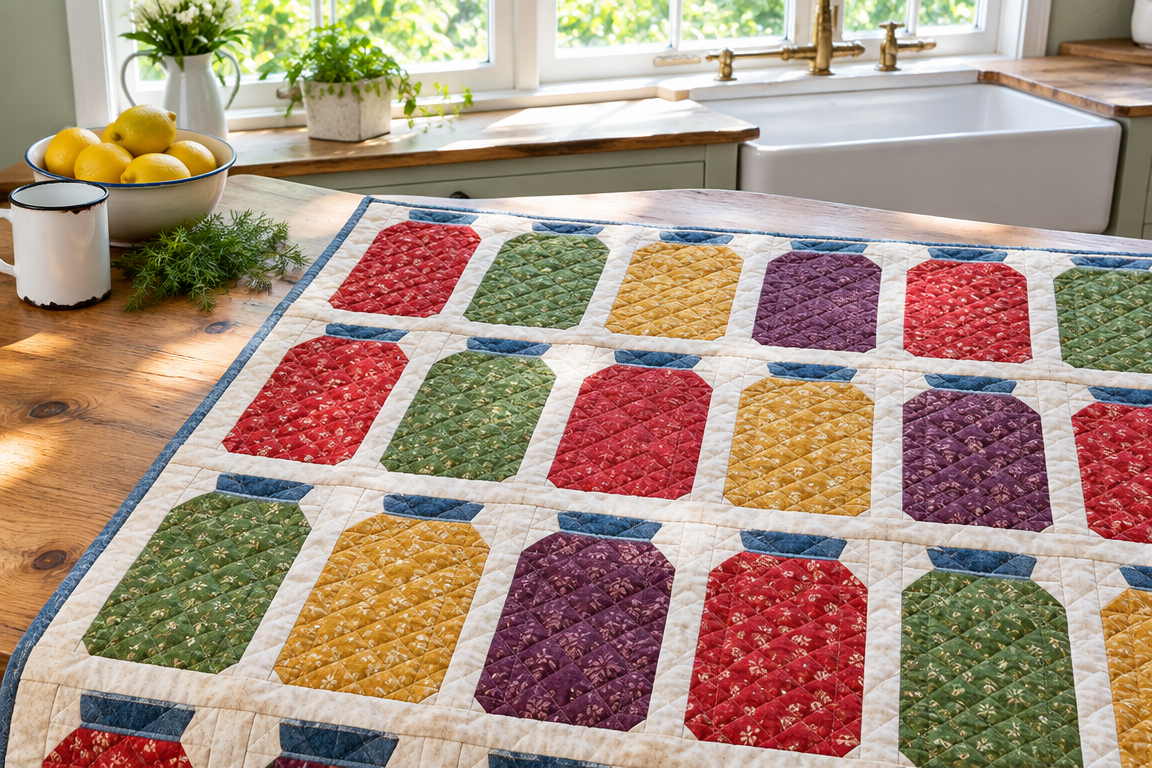
The first time I stepped back and saw tomato red, dill green, honey amber, and plum resting on cream muslin strips, I knew Jars of Late Summer had found its personality.
I especially love the slate-blue half-square triangle jar lids, because they make each block look gently sealed and ready for the next sunny day.
Once the folded-cloth stripe bands came together, the whole quilt started to read like shelves you can almost reach for.
And when it was draped over the kitchen table, morning light made the diagonal quilting look like sunlight moving through glass.
SEE A NEW PATTERN HEREA Pantry-Shelf Look That Feels Like Late-Summer Home
Jars of Late Summer is special because it turns classic canning inspiration into a row-by-row quilted ‘shelf’ you can build one block at a time.
The tall jar blocks give it that satisfying vertical rhythm, while the narrow cream muslin shelf strips keep everything bright and airy.
Those color notes—tomato red, dill green, honey amber, and plum—feel like pantry labels you’d want to read slowly, and I adore how they pop against the soft background.
Even the slate-blue HST lids add a little wink, like the tops are catching light before you store the jars away.
Color-Play with Patterned Cotton and Stripe Bands
I designed this quilt so patterned cotton can shine without getting chaotic, because each jar column carries its own flavor through consistent placement.
For the shelf strips, I like choosing calmer prints or light muslin so the jars read clearly, then letting the folded-cloth stripe bands do the ‘celebration’ work in between.
When you mix in different scales of pattern—small for jar fields, medium for accents—you get movement that still looks organized from across the room.
Materials You Can Hunt for Like Pantry Treasures
- Patterned cotton charm packs or assorted fat quarters for jar bodies and accents: about 2 1/2 to 3 yards total equivalent (or 18-24 fat quarters depending on your choices)
- Cream muslin or light background: about 1 1/2 yards
- Tomato red fabrics for main jar areas and small accents: about 3/4 to 1 yard
- Dill green fabrics: about 3/4 to 1 yard
- Honey amber fabrics: about 3/4 to 1 yard
- Plum fabrics: about 3/4 to 1 yard
- Slate blue for half-square triangle lids and small details: about 1/2 to 3/4 yard
- Stripe fabrics for shelf divider bands (or fat quarter assortment): about 1/2 to 3/4 yard
- Backing (soft gingham, coordinated): about 5 1/2 yards
- Batting (queen-size or your chosen size): about 5 1/2 to 6 yards
- Binding (coordinating solid or stripe): about 3/4 to 1 yard
I always leave a little extra room in my planning, because patterned cotton loves to surprise me once I start fussy-cutting jar details.
If you’re using yardage instead of fat quarters, keep an eye on print direction so the jars stay crisp and the stripe bands look intentional.
Prep Your Workspace Like You’re Ready to Can
Before I sew, I set up a ‘jar sorting’ station with labeled piles so red, green, amber, plum, and slate blue don’t blur together mid-session.
I press every fabric flat and then press again after cutting, because clean seams make those shelf rows look straight and tidy.
For the half-square triangles, I like to take a few minutes to confirm seam allowances and alignment so the lids end up evenly ‘capped.’
Then I stitch in a gentle rhythm, row by row, so the quilt grows like a pantry shelf filling up one jar at a time.
Download the Full Pattern and Piece the Pantry Rows
The complete set of instructions is below the photo in the link, with guidance for layouts, construction order, and finishing steps you can follow at your own pace.
Extra Tips for a Cleaner, Glassy-Look Finish
To keep the rows crisp, I recommend checking row alignment against the cream shelf strips as you assemble, rather than hoping it fixes itself later.
For binding, I like using a solid or lightly patterned fabric so the quilt edge doesn’t compete with the jar colors.
When quilting, the fine diagonal grid works beautifully because it reads like light through glass, especially when you quilt on top of a gingham backing.
Take your time with pressing after each major seam, and the quilt will feel smoother when it’s time to quilt and bind.
A Slightly Advanced Idea: Add More “Shelf Depth”
If you want to level it up, consider swapping the basic quilting grid for a slightly denser diagonal in the shelf areas so the jars feel set ‘in front’ of the background.
You can also experiment with scrap mixing in the jar borders using two repeating prints, because the quilt still stays cohesive while looking richer up close.
And if free-motion quilting calls to you, try it just on the negative space between shelves for a softer, wind-through-the-kitchen feel.
Celebrate Your Finished Pantry Quilt and Keep Creating
When Jars of Late Summer is finished, it feels both practical and nostalgic—like a kitchen memory you can wrap up and use every day.
I love draping mine over a scrubbed pine table with a chipped enamel mug, lemons in a bowl, and one stray sprig of dill to make the colors feel even more alive.
If you’re looking for your next project, come browse more Quilt Dreams ideas on the blog and keep turning fabric into little moments worth keeping.