The first time I pieced a Drunkard’s Path block, it felt like I was learning the ocean’s secret language one curve at a time.
When I designed Low Tide Ripples, I kept picturing tide pools at the very edge of high summer, where everything looks calm but moves underneath.
I wanted the quilt to feel like you could step closer and spot a little flash of color hiding in the foam.
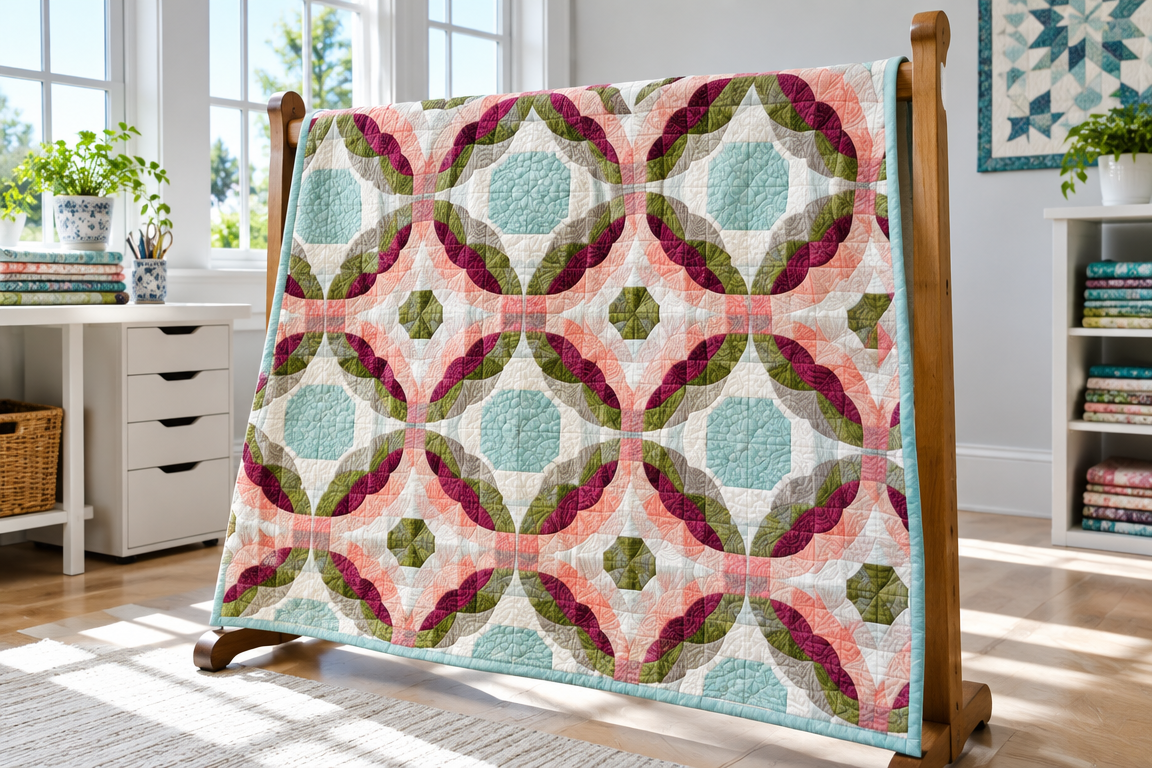
That’s why the quarter-circle blocks become concentric ripple rings, spiraling around octagonal “pools” that sit at the corners like tiny discoveries.
After I draped it outdoors on my sunlit deck, it looked even more like water—especially with the narrow white sashing that reads like foam lines.
And yes, I still love how the palette mixes sea-glass aqua with kelp olive and wet-sand taupe, then lets urchin magenta and sun-bleached coral pop like warmth caught in the shallows.
Why Low Tide Ripples Feels Like a Beach Day
From a distance, the quilt reads as flowing rings that seem to roll across the surface, and up close you can see each octagonal pool framed by curved motion.
The quarter-circle Drunkard’s Path shape adds a gentle swirl, so instead of sharp angles, the whole top feels like tidewater moving around sandbars.
Even though it’s a full-size design, it has a light, airy rhythm thanks to the cool coastal cottons and the white sashing that breaks up the rings like bright foam.
Technique Spotlight: Making the Curves Behave
For this quilt, the magic is in how you handle the Drunkard’s Path curves so the blocks fit together into those satisfying ripple spirals.
I like to sew slow through the curve, keep my stitching consistent, and press with intention so the seams nest cleanly in the ring sections.
When your quarter-circle units line up, the ripple pattern feels like it’s spiraling naturally instead of being assembled in chunks.
A Coastal Palette That Moves with the Light
My fabric play here is all about contrast that still feels gentle—sea-glass aqua and wet-sand taupe cool everything down, while urchin magenta and sun-bleached coral add little bursts of life.
Kelp olive acts like seaweed in the shadows, grounding the pools so the rings don’t float away.
To keep the motion cohesive, I distribute similar tones in different rings instead of repeating one fabric only in one spot.
Materials You’ll Need for Low Tide Ripples
- Coastal prints for ripple rings: 16–18 fat quarters (mix sea-glass aqua, kelp olive, wet-sand taupe, urchin magenta, sun-bleached coral)
- White sashing/foam lines: 2 yards
- Corner pool accents (optional extra contrast selection): 6–8 additional fat quarters
- Backing (single print, sage-aqua style): 3 yards
- Batting (queen-size, warm and stable): 1 queen-size package
- Binding (coordinate with white or a soft sand tone): 3/4 yard for straight-grain binding strips
Because the Drunkard’s Path blocks rely on accurate curve cutting, I recommend buying a little extra white sashing just to stay relaxed if a few pieces need a do-over.
If you want extra depth, choose backing with a gentle texture so your pebble quilting shows up without feeling busy.
Prep Day in My Sewing Space
I start by clearing my table, then I trim and label pieces by ring color group so I’m not hunting when the curves start stacking.
Before cutting, I pre-wash if my fabrics are prone to shrinking, and then I press them smooth so the seam lines stay crisp.
When I’m ready to sew, I use a consistent stitch length for curves and set my iron nearby for quick, careful presses between steps.
Download the Full Pattern (Instructions in the Link)
You’ll find the complete, sewable directions below, including block layout guidance for the concentric ripple arrangement and the pool placement around each block.
The full instructions are below the photo and also in the link, so you can follow along without guessing at assembly steps.
Extra Tips for Cleaner Curves and Crisp Rings
To keep the curved seams tidy, I trim seam allowances carefully on the inside of the curve before pressing so the block doesn’t get bulky at the turning points.
When joining rings, I line up seams like puzzle pieces, then baste first if I’m trying a new fabric combination that day.
For the white sashing, press it flat before attaching so those foam lines stay straight and bright across the waves.
Optional Upgrade: Pebble Swirls in the Pools
If you want the quilt to feel truly like tide pools, try machine quilting with pebble swirls inside each octagonal pool while keeping long wavy lines flowing through the ripple rings.
You can echo the spiral motion by quilting slightly wider curves where the rings feel strongest, which helps the whole top read as one continuous wave.
For an even more advanced twist, add a narrow border that continues the wavy line motif, or mix in a few extra scrap-scale prints so certain ripples catch the eye like sunlight on moving water.
Celebrating the Finish (It’s Like Hearing the Ocean)
When I finally square up the edges and bind it, I always feel like I’m holding a calm shoreline—soft, rhythmic, and full of little surprises.
Once it’s finished, Low Tide Ripples has that cozy “sit and stay” energy, whether you use it as a throw or let it take center stage on your floor.
If you’re hungry for another project, I’d love for you to keep exploring more quilt patterns on the Quilt Dreams blog and keep building your own collection of wave-worthy makes.