This morning I found my Orchard Lantern quilt stretched across the breakfast-nook table, and the sunlight made every orange peel look freshly picked.
When I first drafted the repeating grid, I wanted that hand-appliquéd feeling you can almost hear—soft stitches, little pauses, and then a satisfying curve landing exactly where it should.
I tucked a ceramic bowl of oranges nearby for the photo, and suddenly the warm white background looked like late-afternoon light.
Even the navy binding felt like the quiet “nightfall” moment that balances all that citrus glow.
After I pinned the snapdragon stems in their jam jar by the window, I knew this quilt wasn’t just decorative—it was a daily reminder to slow down and sew with intention.
Why Orchard Lantern Feels Like a Harvest Keepsake
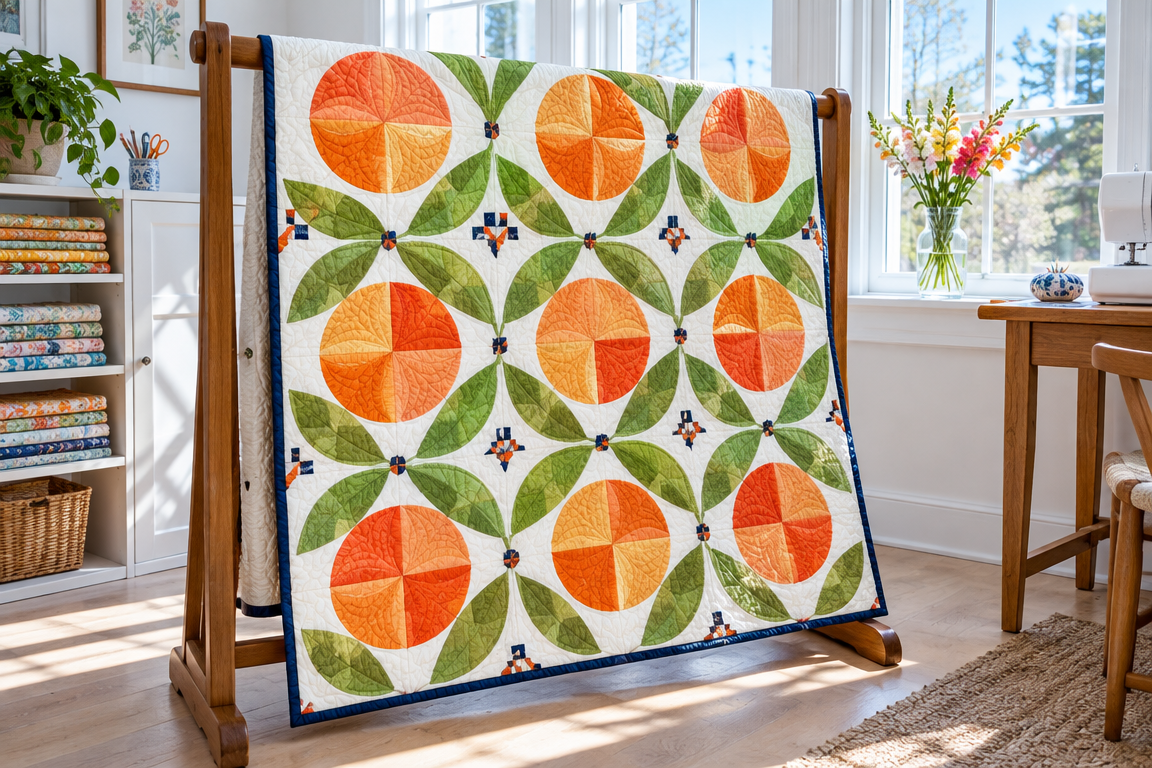
The Orchard Lantern design is a warm, orderly grid of rounded orange-peel appliqué blocks that repeats like a rhythm you can relax into.
Each peel form is stitched down in tangerine, clementine, and persimmon prints, then edged with a lime-leaf green accent so the fruit shapes look softly outlined yet alive.
Those slim four-patch cornerstones at every intersection keep the whole surface from feeling too uniform, like tiny flashes of color between the lantern-bright peels.
Because everything floats on a warm white ground, the appliqué reads clearly and the quilting lines can follow the curves without getting busy.
Color-Play That Makes the Appliqué Pop
I chose layered citrus tones on purpose—each peel shape has enough contrast to stand on its own, but they still feel like they belong to the same orchard.
To get that “handmade harvest” look, I mixed prints that share a similar warmth but vary in scale, so the quilt feels rich without turning muddy.
The lime-leaf edge is the quiet hero, adding a fresh border to the curves so your eyes track every peel detail.
Materials for the Orchard Lantern Quilt
- Orange-peel appliqué prints (tangerine, clementine, persimmon): 2/3 yard total per color group, or about 9–12 fat quarters depending on print size
- Lime-leaf green for appliqué edging: 1/2 yard
- Warm white background: 2 1/4 yards
- Slim four-patch cornerstone prints: 3/4 yard total (mix-and-match)
- Backing fabric: 3 3/4 yards
- Batting: twin size or throw size (about 70 x 90 inches), depending on your chosen layout
- Navy binding: 3/4 yard
I like rounding up a little on the appliqué and cornerstones, because hand work always seems to find a way to make you want “just one more leaf” or “one more peel” when you’re in the groove.
Once you’ve gathered your favorites, I recommend washing and pressing your fabrics so your appliqué edges stay crisp and your finished quilt hangs the way you expect.
Prep the Workspace Like You’re Opening a Little Market Stall
Before I sew, I clear a spot for pinning and smoothing, because Orchard Lantern is all about gentle accuracy.
I press my appliqué pieces flat, trace the shapes, and then keep a small dish for pins right next to my needle so I’m never hunting mid-stitch.
If you’re using a foundation or template method from the pattern, prep it first, then sort your citrus prints by tone so you can build your grid calmly.
Full Instructions Are Below the Photo
All the step-by-step guidance for the repeating orange-peel grid, appliqué placement, and the quilting layout is included below the photo in the link.
Take a look at the finished look, then head to the pattern so you can follow along from placement to binding without guessing.
Tips for a Cleaner Appliqué and a Smooth Finish
For crisp curves, I sew with short, careful stitches and keep my seam allowance trimmed where needed so the appliqué edges lie flat.
When pressing, use a light hand and press from the wrong side whenever possible, so the surface stays smooth and the printed citrus colors stay vibrant.
To keep the grid tidy, I check alignment at each intersection before I commit—those slim four-patch cornerstones really reward careful placement.
A Slightly More Advanced Upgrade: Echo-Curve Quilting
If you want to take it up a notch, quilt fine concentric lines that echo the peel curves, so each orange shape looks gently framed from the inside out.
You can do this by marking light guidelines or using a walking foot for even feeding, and the result will feel like hand-echoed stitching without needing a big machine setup.
For extra variety, try mixing a few background-scale prints in the four-patch corners while keeping the main ground consistent, so the lantern glow stays cohesive.
Celebrating Your Orchard Lantern Quilt
When the navy binding is finally on, Orchard Lantern shifts from “in progress” to that cozy, sunlit statement piece that makes you want to display it where you’ll see it every day.
Now that you’ve stitched one lantern-bright grid, you might find yourself craving another citrusy pattern on Quilt Dreams—because building repeat designs is such a satisfying kind of joy.